
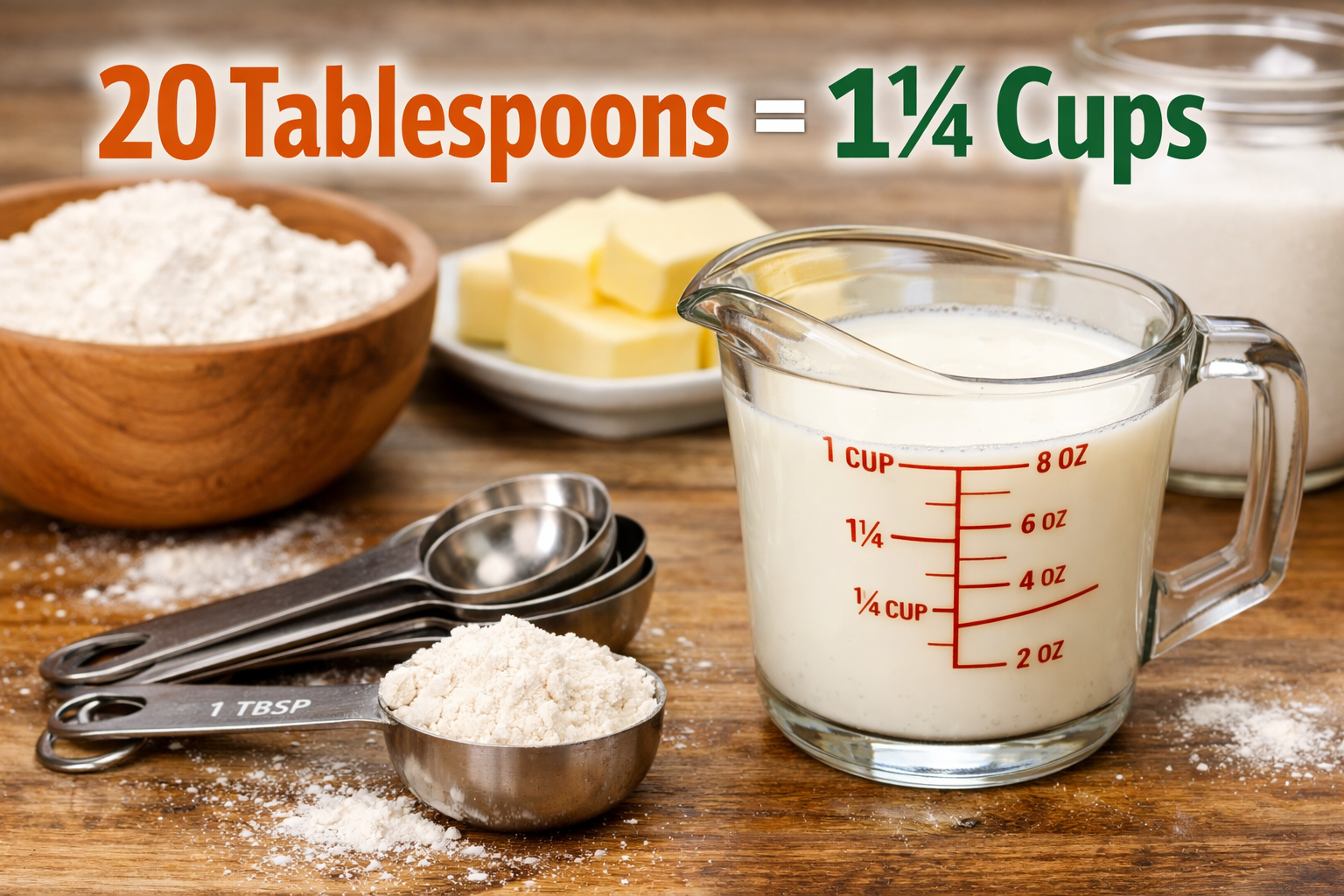
If you’re cooking or baking, measuring ingredients accurately is crucial. Sometimes a recipe calls for tablespoons, but your measuring cups only show cups. So, how do you convert 20 tablespoons to cups? The quick answer is 20 tablespoons equal 1¼ cups. But understanding how this works and seeing it in practical terms can make your kitchen tasks much easier. Let’s break it down.
Understanding Tablespoons and Cups
In U.S. measurements, 1 cup is equal to 16 tablespoons. This means that when you have more than 16 tablespoons, you’re working with more than 1 cup. Knowing these basics allows you to adjust recipes, scale ingredients, or even substitute measuring tools with confidence.
Step-by-Step Conversion of 20 Tablespoons to Cups
Converting 20 tablespoons to cups is straightforward once you know the math:
- Start with the total tablespoons: 20 tbsp
- Divide by the number of tablespoons in a cup: 16 tbsp per cup
- Do the calculation: 20 ÷ 16 = 1.25 cups
So, 20 tablespoons equal 1¼ cups. For practical kitchen use, this means 1 full cup plus an additional ¼ cup. This method works for both dry and liquid ingredients.
Convert Tablespoons to Cups
Practical Examples for 20 Tablespoons
To make it more relatable, here are some examples:
Flour:
20 tablespoons = 1¼ cups of all-purpose flour, enough for a medium batch of cookies.
Sugar:
20 tablespoons = 1¼ cups of granulated sugar, perfect for a cake recipe.
Butter:
20 tablespoons = 1¼ cups of butter, which is 2½ sticks in standard U.S. packaging.
Seeing how 20 tablespoons translates to cups for different ingredients helps you measure quickly without second-guessing.
Example Table: Tablespoons to Cups
| Tablespoons | Cups (Decimal) | Kitchen-Friendly Approximation |
|---|---|---|
| 8 | 0.5 | ½ cup |
| 12 | 0.75 | ¾ cup |
| 16 | 1 | 1 cup |
| 20 | 1.25 | 1¼ cups |
| 24 | 1.5 | 1½ cups |
Tips for Accurate Measurement
Even though 20 tablespoons equal 1¼ cups, precise measurement is important, especially in baking. Here are a few tips:
Level Off Dry Ingredients
Use a spatula to smooth off flour, sugar, or other dry ingredients for accurate measurement. This prevents adding too much, which can affect the texture or taste of your recipe.
Pack Sticky Ingredients Carefully
Ingredients like butter or peanut butter may need light packing to ensure accuracy. This helps avoid measuring more than intended, especially with dense or sticky items.
Use the Same Measurement System
Stick to U.S. tablespoons and cups throughout the recipe. Mixing measurement systems can lead to errors and inconsistent results in your cooking or baking.
Common Mistakes to Avoid
Rounding Too Loosely
Assuming 20 tablespoons is exactly 1¼ cups without measuring can affect your recipe. Small differences can alter the texture or sweetness, especially in baked goods.
Ignoring Ingredient Type
Dense or sticky ingredients may require packing or leveling. Measuring without adjusting for ingredient type can lead to inaccurate results.
Mixing Measurement Systems
Switching between U.S. tablespoons and metric units in the same recipe can be confusing. Stick to one system for consistency.
Conclusion
Converting 20 tablespoons to cups is simple: 20 tablespoons equal 1¼ cups. By understanding the relationship between tablespoons and cups and following accurate measurement tips, your recipes will turn out perfectly every time. Measuring with confidence helps take the stress out of cooking and baking.
If you found this article informative, feel free to check out our other articles as well.
FAQs
Q1: Is 20 tablespoons more than 1 cup?
A1: Yes, 20 tablespoons equal 1¼ cups, so it’s slightly more than 1 cup.
Q2: How many teaspoons are in 20 tablespoons?
A2: 1 tablespoon = 3 teaspoons, so 20 tablespoons = 60 teaspoons.
Q3: Can I round 20 tablespoons to 1¼ cups in baking?
A3: Yes, that is accurate. For precise baking, measuring with cups and spoons ensures consistency.
Q4: How do I measure 20 tablespoons without a tablespoon measure?
A4: Use a ¼ cup measure five times (¼ cup = 4 tablespoons) to get 20 tablespoons exactly.