
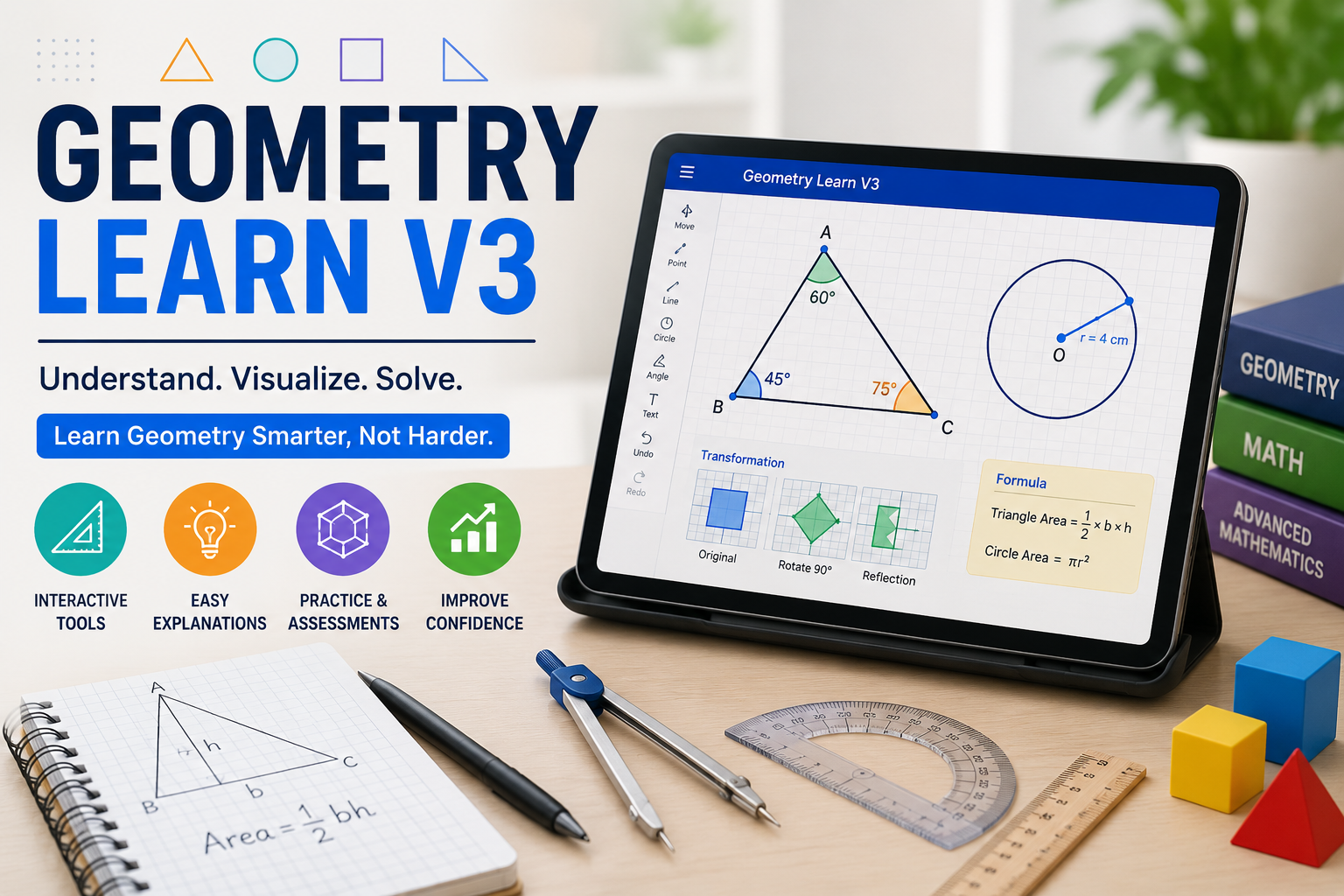
Geometry has always been one of the most visual branches of mathematics. From measuring distances and angles to understanding shapes and spatial relationships, geometry helps us make sense of the world around us. However, many students struggle with traditional learning methods that rely heavily on memorization and static textbook diagrams.
This is where Geometry Learn V3 comes in. Geometry Learn V3 is a modern learning platform designed to make geometry more interactive, engaging, and easier to understand. By combining visual tools, guided lessons, and practical exercises, it helps learners build confidence while mastering important geometric concepts.
Whether you’re a student preparing for exams, a teacher looking for better instructional resources, or simply someone interested in mathematics, Geometry Learn V3 offers an approach that focuses on understanding rather than memorization. In this article, we’ll explore what Geometry Learn V3 is, how it works, its key features, and why it has gained attention among learners and educators.
What Is Geometry Learn V3?
Geometry Learn V3 is an educational learning system that focuses on teaching geometry through interactive experiences. Instead of presenting concepts solely through written explanations, it uses visual demonstrations and hands-on problem-solving techniques to help learners understand how geometric principles work.
The platform aims to bridge the gap between theory and practice. Students can explore shapes, manipulate figures, measure angles, and observe how geometric relationships change in real time.
This interactive approach helps transform abstract concepts into something more concrete and easier to understand.
Why Geometry Can Be Challenging
Before discussing the features of Geometry Learn V3, it’s important to understand why many students find geometry difficult.
Unlike arithmetic or algebra, geometry requires learners to visualize relationships between points, lines, angles, and shapes. Students often need to:
- Interpret diagrams correctly
- Understand spatial reasoning
- Apply formulas to real-world situations
- Prove geometric theorems
- Recognize patterns and relationships
Research in mathematics education has shown that visual learning plays a critical role in developing geometric understanding. When students can see concepts in action, they often learn faster and retain information longer.
Geometry Learn V3 attempts to address these challenges by making geometry more visual and interactive.
Key Features of Geometry Learn V3
Interactive Geometry Tools
One of the most valuable aspects of Geometry Learn V3 is its interactive environment.
Instead of looking at fixed diagrams, learners can:
- Move points and vertices
- Adjust line lengths
- Rotate shapes
- Measure angles dynamically
- Explore geometric transformations
For example, a student studying triangles can change side lengths and instantly observe how the angles respond. This direct interaction helps reinforce geometric principles.
Step-by-Step Learning Paths
Many students become overwhelmed when geometry concepts are introduced too quickly.
Geometry Learn V3 organizes lessons into structured learning paths that gradually increase in difficulty. Learners typically begin with basic concepts such as:
- Points
- Lines
- Angles
- Polygons
They then progress to more advanced topics, including:
- Congruence
- Similarity
- Coordinate geometry
- Transformations
- Theorems and proofs
This progression helps students build a strong foundation before moving on to more complex material.
Visual Demonstrations
Visual learning is one of the platform’s strongest features.
For example, rather than simply presenting the formula for the area of a triangle, Geometry Learn V3 can visually demonstrate how the formula is derived. Seeing a concept unfold step by step often makes it easier to remember and understand.
This approach is especially useful for learners who struggle with purely text-based explanations.
Practice Exercises and Assessments
Learning geometry requires practice.
Geometry Learn V3 includes exercises designed to help students apply what they have learned. These activities may involve:
- Solving angle problems
- Identifying geometric relationships
- Completing proofs
- Calculating areas and volumes
- Working with coordinate systems
Regular practice allows learners to strengthen their skills and identify areas where additional review may be needed.
Topics Commonly Covered in Geometry Learn V3
Basic Geometry Concepts
Every geometry course begins with foundational ideas.
Students typically learn about:
- Points and lines
- Line segments
- Rays
- Angles
- Parallel lines
- Perpendicular lines
These concepts serve as building blocks for more advanced geometry.
Triangles
Triangles are among the most important shapes in geometry.
Geometry Learn V3 often covers:
- Types of triangles
- Interior and exterior angles
- Triangle congruence
- Triangle similarity
- The Pythagorean Theorem
For example, the famous relationship between the sides of a right triangle can be represented as:
Interactive demonstrations help students understand why this formula works rather than simply memorizing it.
Circles
Circles introduce several important concepts, including:
- Radius
- Diameter
- Circumference
- Area
- Chords
- Arcs
Students can manipulate circle measurements and immediately observe how related values change.
Coordinate Geometry
Coordinate geometry combines algebra and geometry.
Learners work with:
- Coordinate planes
- Distance calculations
- Midpoints
- Slopes
- Graphing geometric figures
Understanding these concepts is valuable for advanced mathematics and real-world applications.
Transformations
Geometry Learn V3 also helps students explore transformations such as:
- Translation
- Rotation
- Reflection
- Dilation
By interacting with shapes directly, students gain a clearer understanding of how transformations affect geometric figures.
Benefits of Using Geometry Learn V3
Better Concept Retention
When students actively participate in the learning process, they often remember information longer.
Instead of memorizing formulas for an exam and forgetting them afterward, learners develop a deeper understanding of why the formulas work.
Increased Engagement
Traditional geometry lessons can sometimes feel repetitive.
Interactive activities make learning more engaging by encouraging exploration and discovery.
Supports Different Learning Styles
Not every student learns in the same way.
Geometry Learn V3 supports:
- Visual learners
- Hands-on learners
- Independent learners
- Classroom learners
This flexibility helps a wider range of students succeed.
Improved Problem-Solving Skills
Geometry is not just about shapes and formulas. It also develops logical thinking and analytical reasoning.
By solving increasingly complex problems, learners strengthen skills that can be applied in many academic and professional fields.
Real-World Applications of Geometry
Many students ask an important question: “When will I actually use geometry?”
The answer is more often than you might think.
Geometry plays a role in:
- Architecture
- Engineering
- Construction
- Computer graphics
- Video game design
- Robotics
- Interior design
- Navigation systems
For example, architects use geometric principles when designing buildings, while software developers rely on geometry when creating 3D models and animations.
Understanding geometry can open doors to a wide range of career opportunities.
Is Geometry Learn V3 Suitable for Beginners?
Yes. One of the strengths of Geometry Learn V3 is its accessibility.
Beginners can start with basic concepts and gradually progress to more advanced topics at their own pace. The combination of visual demonstrations, guided instruction, and practical exercises makes it easier for newcomers to build confidence.
More advanced students can also benefit from the platform by reviewing difficult concepts and sharpening problem-solving skills.
Conclusion
Geometry Learn V3 represents a modern approach to learning geometry. By combining interactive tools, visual demonstrations, structured lessons, and practical exercises, it helps transform complex mathematical concepts into understandable and engaging experiences.
Geometry is much more than a school subject. It is a way of understanding patterns, relationships, and structures that exist throughout the world. Whether you’re studying for an exam, improving your mathematical skills, or simply curious about the subject, Geometry Learn V3 provides valuable tools that can make learning more effective and enjoyable.
If you found this article informative, feel free to check out our other articles as well.
Frequently Asked Questions (FAQs)
What is Geometry Learn V3?
Geometry Learn V3 is an interactive geometry learning platform that helps students understand geometric concepts through visual demonstrations, guided lessons, and practice activities. It is designed to make geometry easier and more engaging than traditional textbook-based learning.
How does Geometry Learn V3 help students learn geometry?
Geometry Learn V3 focuses on visual and hands-on learning. Students can explore shapes, angles, transformations, and geometric relationships in real time, helping them understand concepts instead of simply memorizing formulas.
Is Geometry Learn V3 suitable for beginners?
Yes. Geometry Learn V3 is designed for learners of different skill levels. Beginners can start with basic topics such as points, lines, and angles, while more advanced students can explore coordinate geometry, proofs, and transformations.
What topics are covered in Geometry Learn V3?
The platform typically covers a wide range of geometry topics, including:
- Points, lines, and angles
- Triangles and polygons
- Circles and arcs
- Coordinate geometry
- Geometric transformations
- Area and volume calculations
- Congruence and similarity
- Geometric proofs
Can Geometry Learn V3 improve math performance?
Many students find that interactive learning helps them understand concepts more clearly. By providing visual explanations and regular practice opportunities, Geometry Learn V3 can help strengthen geometry skills and improve overall math confidence.
Is Geometry Learn V3 useful for exam preparation?
Yes. The platform’s structured lessons and practice exercises can help students review important geometry concepts commonly found in school exams, standardized tests, and competitive assessments.
How is Geometry Learn V3 different from traditional geometry learning?
Traditional geometry often relies on static diagrams and memorization. Geometry Learn V3 uses interactive tools that allow students to manipulate shapes and see geometric relationships in action, making learning more engaging and easier to understand.
Can teachers use Geometry Learn V3 in the classroom?
Absolutely. Teachers can use the platform to demonstrate geometric concepts visually, create interactive lessons, and provide students with additional practice outside the classroom.
Why is geometry important in real life?
Geometry is used in many fields, including architecture, engineering, construction, computer graphics, animation, robotics, and design. Understanding geometry helps develop logical thinking and problem-solving skills that are useful beyond the classroom.
Is Geometry Learn V3 worth using?
For students who struggle with traditional geometry lessons or want a more interactive way to learn, Geometry Learn V3 can be a valuable educational resource. Its visual approach helps make complex concepts easier to understand and remember.